
why sbi cards share prices are falling

SBI Cards shares hit 52-week low; what’s hurting the stock now
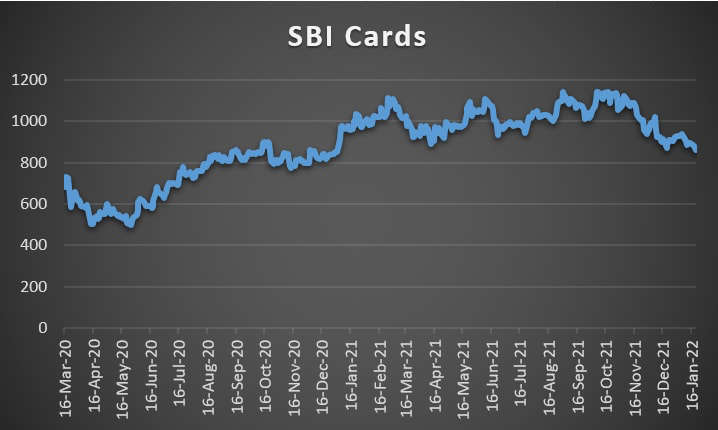
SBI Cards and Payment Services shares fell nearly two percent to a fresh 52-week low on Friday, adding to investors’ concerns as the stock entered the sixth session of losses in a row.

SBI Cards is due to report its financial results for the October-December period on January 24.

For the second quarter of the current financial year, SBI Cards and Payment Services reported a year-on-year rise of 67.3 percent in net profit to Rs 344.9 crore. Its revenue, however, declined 8.1 percent to Rs 1,173.2 crore.

The SBI Cards stock fell as much as 1.9 percent to Rs 845 on BSE, breaching its existing 52-week low of Rs 857.2, hit on Thursday.

Prior to Friday’s fall, SBI Cards shares had declined almost four percent in five back-to-back sessions.

Passive investing in an index fund is a good way to ensure your own returns roughly match the overall market. Active investors aim to buy stocks that vastly outperform the market – but in the process, they risk under-performance. Investors inย SBI Cards and Payment Services Limitedย (NSE:SBICARD) have tasted that bitter downside in the last year, as the share price dropped 13%. That falls noticeably short of the market return of around 36%. We wouldn’t rush to judgement on SBI Cards and Payment Services because we don’t have a long term history to look at. The share price has dropped 20% in three months.

Given that the market gained 36% in the last year, SBI Cards and Payment Services shareholders might be miffed that they lost 13%. While the aim is to do better than that, it’s worth recalling that even great long-term investments sometimes


Have feedback on this article? Concerned about the content?ย Get in touchย with us directly.

Trade less more money

India’s No. 1 brokerage company owner nithin kamath what he said?

Trading actively is the toughest way to make easy money in life, unlike what most people think. Also, it can be quite stressful & stress can snowball.

To trade well, you need to trade lessโ€”both no of trades & capital. -nithin kamath ( zerodha co- founder)

This just made me realiseโ€”once againโ€”that nothing is more important than good health and leading a stress-free life

The key to leading a stress-free life is to get rid of all the unnecessary sources of stress, which we artificially impose on ourselves. No points for guessing – active trading is one. Active trading is a serious source of stress, and unfortunately, no one talks about it

Most folks trade for the heck of it. Common reasons include โ€˜I donโ€™t want more, even if I can make enough for daily expenditure thatโ€™s good enough for meโ€™. And their daily expenditures include their daily cigarettesโ€”the irony ๐Ÿ˜โ€”and tea expenditures

It starts with this premise and then quickly escalates to betting their house on Bank Nifty. Yes, you can risk manage and put a stop loss to your trade ๐Ÿ›‘

But unfortunately, there is no stop loss to the financial stress and the impact on your cardiac health from active day trading. Every time a trade goes against your position, knowingly or unknowingly you are under stress and this can affect your health

The question you need to ask yourself is – is it worth it? Yes, the capital market is a serious source of wealth creation and everyone in this day and age should have exposure to markets. But there are many ways to do this smartly without taking on stress

For example- make long term investments via mutual fund, outsource your stress to a professional who knows how to deal with this. It does not make any difference if you trade and generate 10% or if a fund manager does it for you

Or if the stock market is what rocks your boat and you feel โ€˜compelledโ€™ to trade, at least stick to positional trades where you have the luxury of time to think and plan without taking on stress

Or if you like trading actively, at least make sure you have the ability to realise when to cut and get out. Your time is probably better spent in doing things where you have an edge

So before you decide to take a plunge into trading actively, just don’t think about the monetary risk factors, think about the financial stress and the long term impact on your well-being. Stay healthy, stay stress-free.

Source Twitter : nithin kamth post

Explained by karthik rangappa
(author : Zerodhavasity)

Thank you for reading follow for more content realted business and stock market related posts

5 Multibagger stocks in upcoming decade

Potential Stocks to hold for long term

Top 5 potential stocks hold for long tert with reason

Which 5 Indian stocks are most likely to get a return in 2021-22, and why?
1.Reliance industries

Reason: this industry have lots of future plans like retail stores and go gas oil business and communication community all other

2.Tata power

Reason: as we know in future there is a electric vehicles trend so tata power is largest power company in India it is going to be place lots of power station required to India and much more plans in future

3. Pi industry

Reason : this company products like fevikwik, FEVICOL, m-seal, Dr fix it many others products are in market there is no competition to these products as of now and in future also and now this shares is down by 10 % from high it is good to buy in dip

4. Asian paints

Reason : in paint company this is multinational brand and good product

5. United’s spirit

Reason: this is wine company in India it has 70% wine brand own by this company only and by price action view this gave breakout of 6+ break out I hope it’s multi bugger stocks in future

If you like this content please follow us for more content about stock market related

Follow US

Thank you,

Price action is more better for trading?

Hi every one,

What is price action?

  • Price action is the movement of a security’s price plotted over time. Price action forms the basis for all technical analysis of a stock, commodity or other asset chart. Many short-term traders rely exclusively on price action and the formations and trends extrapolated from it to make trading decisions. Technical analysis as a practice is a derivative of price action since it uses past prices in calculations that can then be used to inform trading decisions.

Key take away for price action

  • Price action generally refers to the up and down movement of a security’s price when it is plotted over time
  • Different looks can be applied to a chart to make trends in price action more obvious for traders.
  • Technical analysis formations and chart patterns are derived from price action. Technical analysis tools like moving averages are calculated from price action and projected into the future to inform trades
Continue reading “Price action is more better for trading?”